
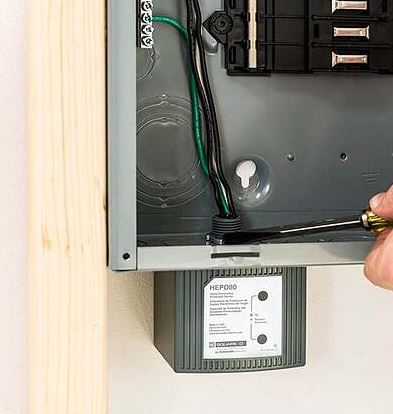
A surge protector is an extra line of defence for your electrical panel
Most often, the electrical panel will do a good job at maintaining safe voltage, but sometimes faltering during unexpected large surges in electricity (i.e. a lightning strike on a transformer). During surges, incoming electricity from the utility company quickly reaches extremely high voltage levels that may pass through the panel and onto your electrical devices throughout your home.
Surge protector devices efficiently absorb and redirect excess voltage to the ground, ensuring the safety of your home. The device safeguards your sensitive electronics items such as your computer, TV, home entertainment centre, and more in your home, office, or business.
For homes, offices, or businesses where voltage-sensitive loads and uninterrupted power are essential, it is advisable to invest in both surge protectors and UPS systems.
Adding an Uninterrupted Power Supply (UPS) as an additional layer of protection. A UPS not only shields your sensitive devices from power surges but also provides temporary power during outages until regular power is restored.
Frequently Asked Questions
What is the expected cost of installing a surge protector?
The average cost is approximately $300 to install a surge protector on a residential panel. Commercial installations may be more due to the voltage demand and a building having multiple panels.
What is a power surge?
Power surges manifest when the electrical flow is abruptly halted, then started again, or when an external factor directs electricity back into the system. These surges can vary from a modest five or ten volts, such as when turning on a hair dryer, to the magnitude of thousands of volts in the event of a lightning strike on a transformer.
What causes a power surge?
Power surges can stem from various factors such as, electrical overload, defective wiring, lightning strikes, and the re-establishment of power following an outage or blackout.
Is a power bar a sufficient power surge protector for my electronics?
Not all power bars provide surge protection, and older models may offer minimal or no defence against power surges. Power bars should be explicitly labelled as surge protectors and another way to distinguish between a surge protector and a standard power bar, is to check for the term “joules” on the packaging or the power bar itself.
Surge protectors consistently feature a joules rating, indicating the maximum voltage they can withstand during a power spike. In contrast, power bars primarily serve as extension cords, offering additional outlets but lacking a joules rating.
Uninterrupted, uncompromised power